8 March - 6 April
Read on Substack
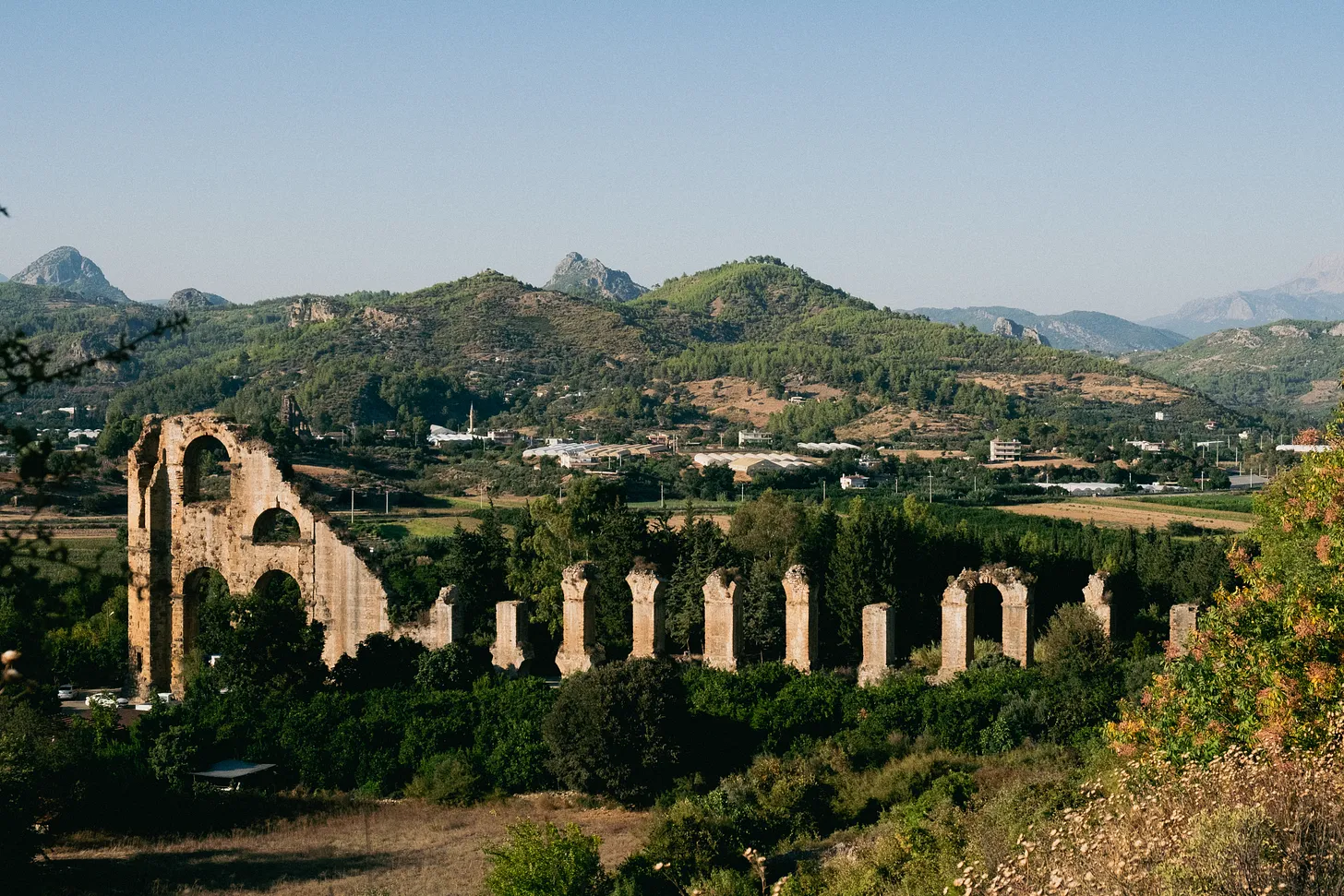 Aspendos, Turkey (September 2022)
Things lived
When I leave the movie theatre at 11pm along a long stretch of black road, I find a neon green sign a few metres down on the dark wall, flickering every few seconds. I run across the road to see it, partly obscured as it is by the upper branches of a tree:
PICTURE HOUSE
I take a photo. And then I take a video. And it is only as I am taking a video that I realise the flickering isn’t random. As I stand there, phone in hand, certain of the letters fizzle out so that the phrase it now spells, like a blackout poem, is:
CURE US
And then it’s gone, and I have to watch the video back to make sure I hadn’t dreamt it. But there it goes again — cycling, cycling.
A plea? A direction? A promise?
To whom?
•••
For so many of the days of this month, being alive has felt like nails on a blackboard. So many mornings, I’ve had to drag every leaden inch of myself out of bed and push myself through every minute, every hour. So many nights, I’ve felt the cold grip of loneliness echoing still amidst the music I use to try and drown it out.
When I had sleep anxiety back in 2016 and slept, on average, one or two hours each night for the first half of the year, I clung, half-delirious, to the idea that a bad night doesn’t mean a bad life. I rarely have the problem now (I taught myself how to fall asleep, a fairly harrowing task), but I had to hold onto the thought yet again as I clawed my way through every morning and called it each night, disappointed in all I had failed to do. A bad day doesn’t mean a bad life. It’s true, but these days — they are our lives. There is nothing more than each moment. Over and over, throughout the month, I wrote: I would like to live my life.
•••
Don’t we all?
Against my will, I’ve begun doing the thing that I used to complain about my parents doing all the time: going to every Malaysian food place in the area just to find a piece of home. I found a new one just two train stations away from me in a food court sunk below the street. It was a Sunday, so all the other stalls, bar another, were shut. A couple in their 30s was running the shop, and three restless kids ran up and down the narrow space behind the counter.
I realised with a pang that I was closer in age to the parents than to the children. It’s only natural to age and find yourself sympathising with who everyone once might’ve been at your age. Lost, scared, tired. All at a time when I thought I’d have it mostly figured out, or at least the next few steps in front of me. In truth, there’s been a terrible fog and it hasn’t lifted. But I felt bad in how I’ve been thinking of my life as a grind — my life where, outside of work, all my hours are for me. And my heart went out to them, as it always does when I imagine how most people aren’t living the lives they might have always dreamed of. How we all have dreams and what-ifs. How hard these people are working so their kids might live better lives. How they aren’t so much older than me. How these kids will resent these hours but when they grow up, they’ll want nothing more than to be able to go back. I wandered around the food court where a few people sat around under slow-turning ceiling fans and a distant sunlight filtering through a window in the roof, imagining I was in a place not too different from this that I hadn’t been in for the better part of a decade.
But time steals everything from us. It wears us away, our lives, like standing on the shore to find the tide receding, except it never comes back. Technology might be able to overcome space, but it hasn’t yet been able to overcome time. The videos we create, the memories that plague us, are all just spectres that taunt us, reminding us of all we had and all we can never grasp again.
•••
That same day, my uncle died of a heart attack. This isn’t mine to write about, but I talked to my dad more in those days than I had in the whole year. The same went for him and his sisters who started calling for hours each night to mourn. The transience of the world is thrown into sharp relief. Here one day; gone the next.
Because the older folk have taken an intense liking to recording everything and sharing it with their friends over WhatsApp, we received numerous pictures and videos from hospital to burial and each ritual ceremony along the way. The gathering at the house. The coffin being lowered. The mound of dirt beside it. A grainy video shows a line of people streaming across a small, grassy valley up to the grave beneath blue gazebos. My aunt’s voice from behind the camera as she watches, looking back — wry, sad, resigned — goodbye to the world.
•••
Inscribed: Don’t think just move
•••
Even amongst the loneliness, I spent more time with friends this month than I have in most other months. It hasn’t been out of any particular effort of mine — people just started reaching out. Times like these, I’m grateful for what looks like serendipity. The deus ex machina reaching into the pit. More often than I care to admit, things have come to me when I needed them most. A book, a song, a message. Or perhaps it’s not that they came to me, but rather that I was, for whatever reason, suddenly ready in a way to perceive a particular string of words or events that I hadn’t been before.
It’s attention — attention tuned to the right kind of radio waves. The poet Kaveh Akbar once talked about the idea of “pronoia” as the opposite of “paranoia”, and this is the idea that the universe is looking out for you. There is a part of me that believes whatever you put out into the world, you will get back in some way, shape, or form. It may be little more than our pattern-hungry brains deciding that some object or some concept is now salient to it, and therefore seeks it out. But if it works, it works. Shut up and take the money.
I’d spent the month believing it was little more than a grating sound, but there was many a melody and sometimes the beginnings of a symphony. As I explain below, I’ve been going through Radiohead’s discography in chronological order, and I’ve just finished Hail to the Thief, which has the song “There, There”, which has the lyric: Just ‘cause you feel it doesn’t mean it’s there.
•••
It’s for GoodFellas (1990) that I have come to the cinema alone and staggered out, astounded. Very little beats a good story well told, and GoodFellas allows itself the time to tell that story. To linger, to expand. Roger Ebert wrote: “the mood of the characters lingered within me, refusing to leave. It was a mood of guilt and regret, of quick stupid decisions leading to wasted lifetimes, of loyalty turned into betrayal. Yet at the same time there was an element of furtive nostalgia, for bad times that shouldn’t be missed, but were.” Bad times? What I think Henry misses at the end, what I could feel missing in myself the whole month, was the thirst for and the thrill of life, of truly living. It sours, of course, and becomes ridden with guilt. Life pales to a sad wreck of itself, unrecognisable. But still, we cannot look away because, my god, how they’d lived…
This is at the theatre that bears the PICTURE HOUSE sign asking, promising a cure. CURE US / PICTURE HOUSE / CURE US / PICTURE HOUSE / CURE US. And, in all truth, I feel a sudden buoyancy as I round corner after corner of drunkards and pretty girls and bright lights in the approach to midnight. Something so beautiful about this time of night, and I can see again — I can see, in every dank stretch, a glimmer of beauty, however fleeting.
As we are now, we have only this life, but it can take a revelation to see it. In that flame of a moment, I find myself a little bit cured.
Things loved
1: On time
I’m always thinking about time. L.M. Sacasas, in one of his brilliant instalments “Whose Time? Which Temporality?”, writes of how we once operated in the matrix of natural time. But the subordination of that to a machine greater than ourselves has dislodged our rhythms:
“Inhabiting the order of measured, quantified time, as most of us do, already inhibits our capacity to imagine another way of being in time. Our enclosure within the human-built world, in both its analog and digital dimensions, obscures the markers of alternative temporal orders. It is possible, of course, to frame this as a liberation from the limits of time just as it is possible to frame our uprootedness as a liberation from the constraints of place. And, indeed, it sometimes is just that. But it is also possible that our liberation from older cultural forms, forms which were more directly informed by a place and its time, has been used against us. To be disembedded and desynchronized is also to become subject to the stochastic order of the digital economy.”
Relatedly, I’m always thinking about rituals. In an interview with Noema Magazine, Byung-Chul Han talks about our need to have temporal structures that stabilise life, and one such technique for this is the ritual:
“Rituals can be defined as temporal technologies for housing oneself. They turn being in the world into being at home. Rituals are in time as things are in space. They stabilize life by structuring time. They give us festive spaces, so to speak, spaces we can enter in celebration.
As temporal structures, rituals arrest time. Temporal spaces we can enter in celebration do not pass away. Without such temporal structures, time becomes a torrent that tears us apart from each other and away from ourselves.”
2: On repeat
- OK Computer by Radiohead
- Yes, the whole album. I’ve been going through Radiohead’s LPs in chronological order. It’s a far more coherent way to experience music, and it’s something of a revelation to hear a band or an artist move through and towards a particular sound. To articulate through time. I struggle with Spotify sometimes because it fragments music — it makes an artist’s reputation depend on one song. Or, not even one song, but the 30-second hook in a song where you’re either in love or indifferent. And it makes my brain feel the way I feel jumping from social media platform to social media platform: exhausted, frazzled, unfulfilled. Whereas here, I was delighted to follow the thread from the rock beginnings of Pablo Honey to the ambient sounds of Kid A and the revelation of the closing jazz piece on Amnesiac.
- OK Computer is the first tipping point between the alt-rock / Britpop / U2-esque sound that Radiohead began with and the quick shift into Aphex Twin-type ambience of Kid A. An incredible blend, something of an opera, and a perfect concept album. The twentieth anniversary edition, OKNOTOK 1997 2017, is also not to be missed.
- Ceilings (live acoustic) by Lizzy McAlpine
- I love pop songs that sound happy even as the lyrics are devastating. Robyn is the queen of this. The climax of “Ceilings” by Lizzy McAlpine follows a chord progression whereby the most triumphant-sounding part is, lyrically, a desperately lonely realisation where we realise the story of this budding relationship has all been a daydream.
- Eucalyptus by The National
- My spiritual fathers have returned and it sounds like 2010 again. I can’t believe I’ve gotten to an age where the nostalgia is so strong that I couldn’t even tell you whether the song is good or not; I just love it.
3: Excerpted
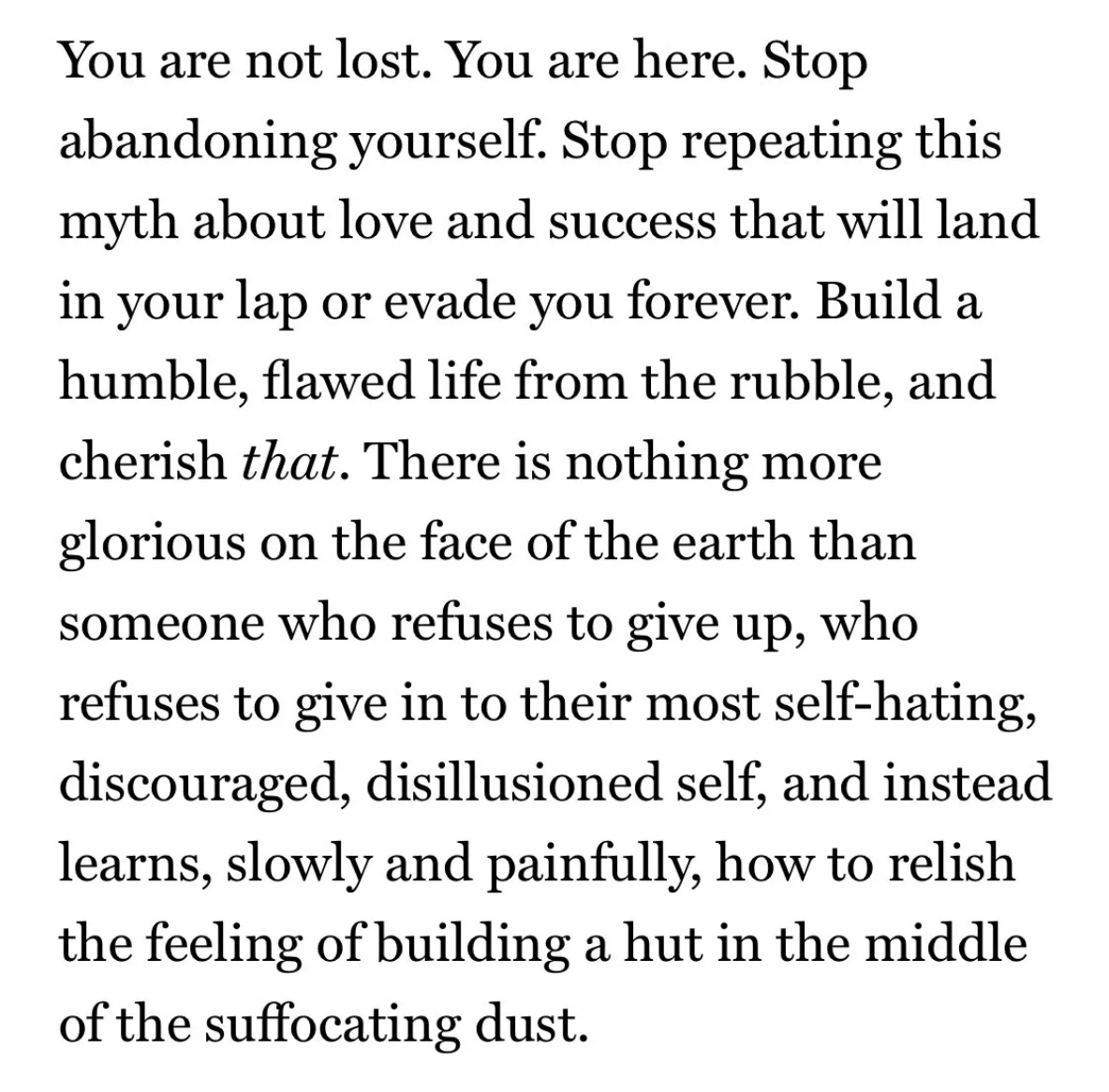 from The Cut’s “Ask Polly: Why Should I Keep Going?"
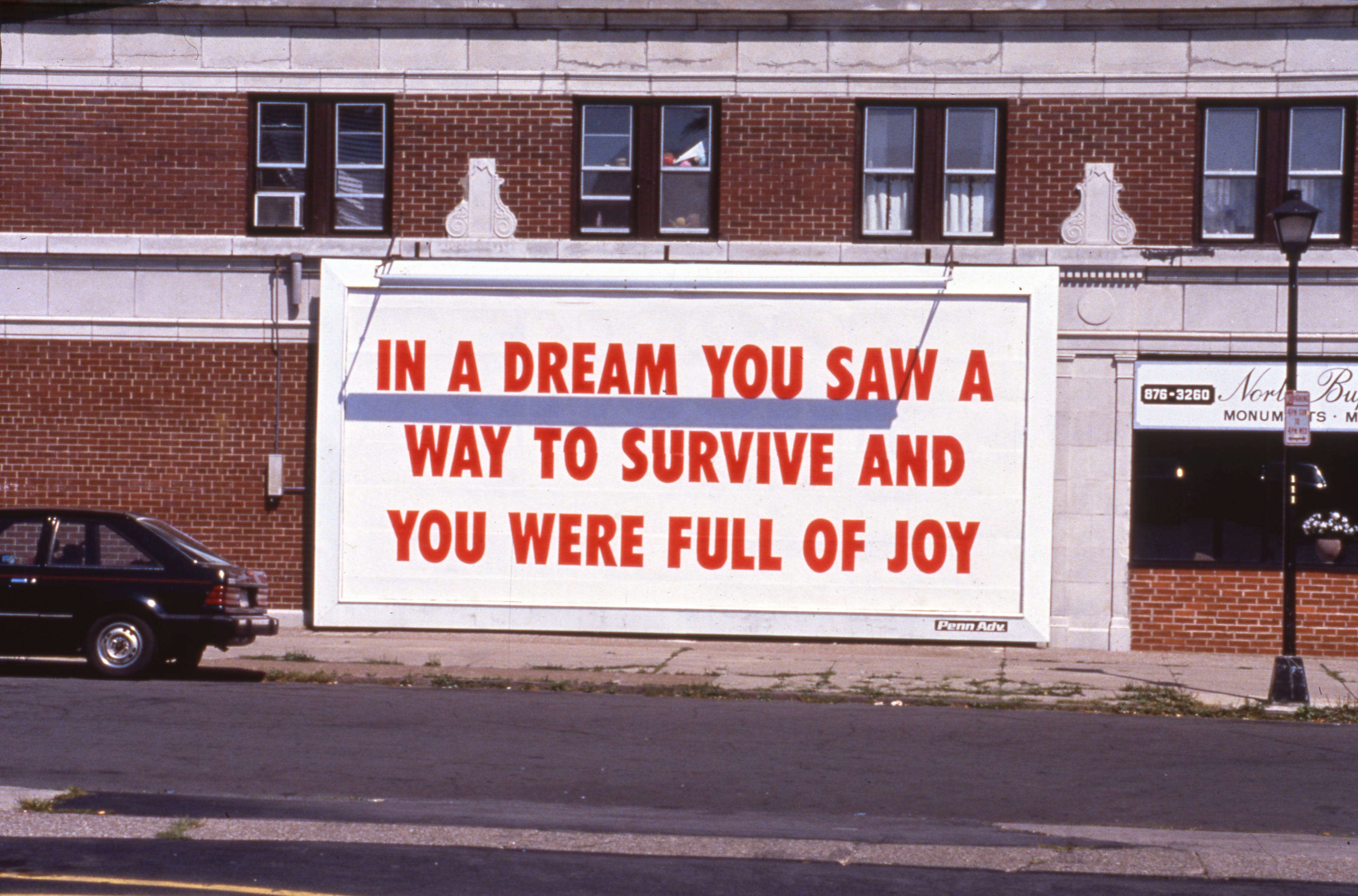 Jenny Holzer, from Survival (1983-85)